Exhibition Stand Builder for London Tech Week
London Tech Week's expo runs 7–9 June 2027 at Olympia London. We design and build exhibition stands for it: space-only stands for scale-ups and corporate technology exhibitors, and multi-company pavilions for national delegations and startup groups, in custom wooden construction or on our DUM FLEX™ frame. Our work on that floor: a 450 m² national startup pavilion holding 55 companies.
Get a quote →Our work at London Tech Week
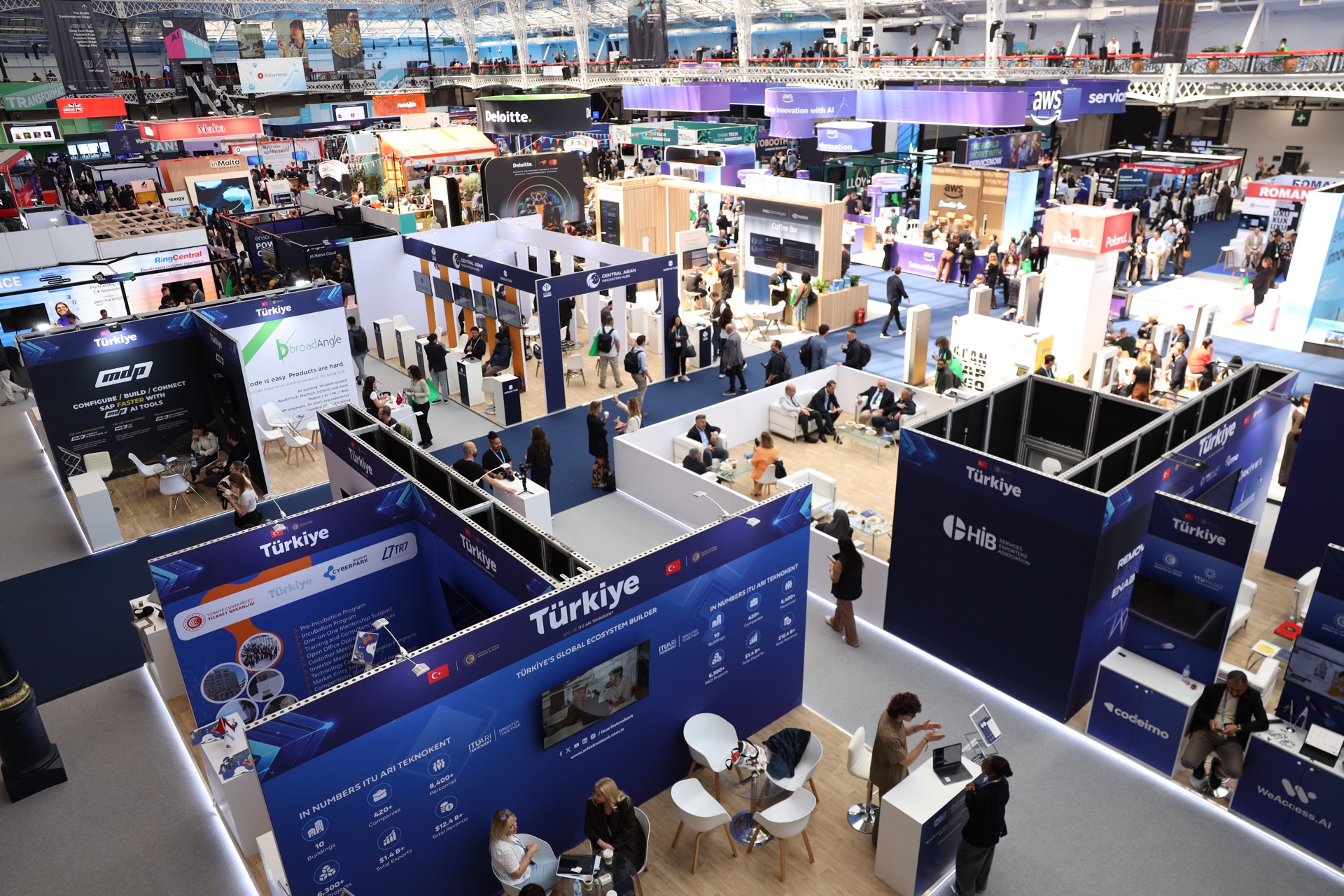
A national startup pavilion for the Government of Türkiye: 450 m², 55 companies, each with its own branded position inside one structure, with shared meeting and hospitality zones, built on a DUM FLEX™ frame inside an Olympia tenancy. Open the project and look at it.
What you are exhibiting into at London Tech Week
London Tech Week is a festival with an exhibition at its centre. The expo and content stages sit at Olympia London for three days, and a fringe programme runs across the city around them. That shape decides who walks past your stand.
Three days at Olympia, a week across London
The organiser, Informa Connect with London & Partners, runs the expo and content stages at Olympia London on 7–9 June 2027, with fringe events across the city from 7 to 11 June. Visitors move between stages, meetings and the show floor all day, so a stand here has to catch people in motion: founders, investors, corporate innovation teams and public-sector buyers, many of them on their way to a session.
Startups, scale-ups, corporates and national pavilions on one floor
The floor mixes small startup positions, scale-up stands, corporate technology exhibitors and national pavilions, each hosting its own group of companies. Next to a national pavilion with dozens of companies inside it, a single small startup position needs a clear message at eye level and one thing worth stopping for. Next to a startup row, a corporate stand needs to look approachable rather than closed. We build for all of them, and the first thing we ask is which of those neighbours you will have.
Shell scheme or space-only
Space is sold two ways. A shell scheme gives you walls, a fascia and basic power, and your job is what goes inside it. Space-only gives you bare floor and a set of stand-build rules, and everything on it is designed, drawn, submitted and built. Pavilions and larger corporate stands are almost always space-only. Which one fits depends on the plot and what the stand has to do (our shell scheme vs space only guide sets out how we decide), and we will say which before drawing anything.
Designing a pavilion for many companies at once
A national or group pavilion at London Tech Week is a different design problem from a single-brand stand. The host wants one identity from the aisle. Every company inside wants to be found. Both have to be true at the same time.
One identity from the aisle, every company visible inside
For the Türkiye pavilion the brief was 55 startups in 450 m², presented as part of one national technology ecosystem. The answer was a consistent visual system across the whole structure, with each company's graphics and content kept clearly identifiable inside it. From a distance the pavilion read as Türkiye. At two metres it read as the company in front of you. That balance is set in the drawings, and it is the first thing we work out with any pavilion host, whether the group is five companies or fifty.
Every company needs a place to have a conversation
A pavilion position is small, and it still has to work as a stand. Each company needs a branded touchpoint, somewhere to show a product or a screen, and a place to talk to a visitor without standing in the circulation route. Around those positions sit the shared parts: meeting points, hospitality, seating for networking and a reception where the host organisation runs the space for three days. Open circulation through all of it matters more than any single wall, because a visitor who cannot get in does not stop.
One contractor for the whole pavilion
Dozens of companies means dozens of positions to power, brand and connect, and a lighting scheme that treats the pavilion as one space. We plan the services with the stand plan, integrate screens and graphics into the structure and coordinate the venue orders, so the host has one contractor, one drawing set and one point of contact. For a delegation arriving from outside the UK, which is what most national pavilions are, we run the project end to end: brief, design, venue coordination, production, graphics, AV, logistics, installation, on-site management and dismantling.
Building to the London Tech Week manual at Olympia
London Tech Week publishes its exhibitor manual openly. One height line, a set of deadlines and the venue's own conditions decide most of what a space-only stand can be, and they decide it months before June.
Four metres is the line
Under the show's space-only rules, a stand over four metres high, including any flooring or a lighting rig above it, is treated as a complex build and goes in for approval with structural detail behind it. Some designs under four metres can be classed as complex too, depending on stability, and anything rigged above the stand needs the organiser's approval on top of that. Most single-storey stands are therefore designed to sit under that line, and anything that wants to go above it is decided at the drawing stage with the paperwork planned in. Olympia adds its own conditions on rigging, fixings and vehicle access; those are on our Olympia page.
Stand plans are due weeks before June
Space-only stand plans, health and safety documents and rigging requests all have deadlines in the organiser's manual, and they land well before build-up. Vehicles into Olympia are booked into timed slots and the site caps vehicle height at 4.4 metres. We prepare the stand-plan pack, the risk assessment and method statement and the material certificates as part of the build and submit them to the organiser's dates, so approval sits on the programme rather than at the end of it.
Custom wooden construction or the DUM FLEX frame
We build two ways and the brief decides which. Custom wooden construction from our own workshop is the right call when the stand is the statement: a corporate presence with an enclosed meeting room and a feature ceiling, or a shape the frame cannot take. Our bespoke page covers that work. DUM FLEX™ is an aluminium frame finished with tensioned fabric graphics and extended with custom wooden elements where the design asks for it; it goes up fast in a short tenancy and packs into fewer vehicle movements, which is why the Türkiye pavilion was built on it. The frame system is ours and returns to our stock between projects, which is the reusable structure the organiser's Better Stands requirement asks for. Both are engineered to stand free on Olympia's floor, because nothing there is fixed to the building. The system is described on our modular stands page.
Exhibiting at London Tech Week: the questions we get asked
When and where is London Tech Week 2027?
The expo and content stages run 7–9 June 2027 at Olympia London, with a fringe programme across the city from 7 to 11 June. Dates and the venue are published by the organiser on londontechweek.com; we design to the current exhibitor manual for that edition.
Should we take shell scheme or space-only?
It depends on plot size and what the stand has to do. A shell scheme suits a small position where the message is one wall and a screen. Space-only suits anything with a meeting area, a product display or more than one company inside it, and it comes with a stand-plan submission. Send us your plot and we will say which one fits.
How tall can a stand be at London Tech Week?
Under the show's space-only rules, anything over four metres, including flooring or a lighting rig above the stand, is treated as a complex build and needs structural approval. Most single-storey stands are designed under that line. Going above it is possible but is decided at drawing stage with the paperwork planned in.
Can you build a national or group pavilion for a large number of companies?
Yes. The Türkiye national startup pavilion at London Tech Week was ours: 450 m² holding 55 companies, each with its own branded position, plus shared meeting, hospitality and networking zones under one identity. We have also built multi-company pavilions for a trade association and for startup groups at other shows.
We are exhibiting from outside the UK. Can you handle everything?
Yes. We work in the UK, Europe and the Middle East, and for an overseas exhibitor or pavilion host we run the project end to end: brief, design, venue coordination, production, graphics, AV, logistics, installation, on-site management and dismantling. Your team lands in London with the stand already standing and a contractor already in the hall.
Do you only build pavilions at London Tech Week?
No. The pavilion is one project on that floor; the same team designs and builds single-company stands there, from a compact scale-up position to a corporate presence with meeting rooms, in either build approach. Send us the plot and the brief.